Build the arrival plan
The physical transition from international flights and long-distance rail hubs to rural perimeter wristband gates dictates your first 24 hours of festival endurance.
International Gateway Connections
Most major European greenfield events do not sit directly near international airports. Attendees must navigate a multi-tiered connection route:
- Brussels Airport (BRU) / Charleroi (CRL) → Tomorrowland: Dedicated official Global Journey buses or Belgian Rail (SNCB) to Mechelen / Boom with local shuttles.
- London Heathrow / Bristol → Glastonbury: Great Western Railway (GWR) to Castle Cary, followed by mandatory festival connection bus services to Pedestrian Gate A.
- Budapest Ferenc Liszt (BUD) → Sziget: Airport bus 100E to central Deák Ferenc tér, transfer to Metro Line M2, then suburban rail HÉV H5 to Filatorigát.
- Nantes Atlantique (NTE) → Hellfest: TER regional rail to Gare de Clisson, followed by marked walking trails or station van shuttles to the complex.
Train vs. Car vs. Official Coach
Bringing private motor vehicles into festival perimeters introduces steep environmental tariffs, parking voucher requirements (often selling out months early), and multi-hour outbound gridlocks during post-headline departures.
Official Coach Packages: Services organized via partners like Big Green Coach (UK) or event-chartered luxury coaches directly access dedicated bus terminals inside perimeter security lines, bypassing the public parking trek entirely.
Setting Up Camp: Ground Tactics
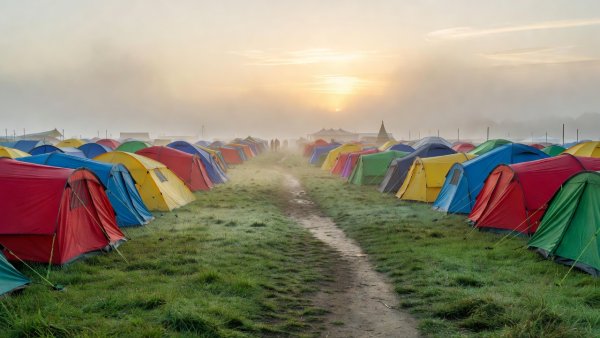
Arriving at a massive open greenfield involves selecting ground strategically. Pitching immediately adjacent to the main perimeter gate or path entrance subjects your tent to continuous 24-hour foot traffic, nocturnal noise, and floodlight glare. Pitching at the deepest perimeter edge adds an unmanageable 30-minute walk every time you return for dry clothing.
- Elevation: Always inspect topographic contours. In wet weather, depressions in pasture grass become water pools. Pitch on slightly elevated crown slopes.
- Distance from Latrines: Establish camp at least 50 to 75 metres from portable toilet stations to avoid odor downwinds and nighttime servicing vehicle noise.
- Peg Anchoring: Traditional flimsy wire pegs fail in rocky ground or soft mud. Heavy-duty ribbed steel pegs prevent tent flysheets from tearing loose in high winds.
Essential Hardware Specification
| Equipment Category | Minimum Recommended Standard | Critical Failure Risk to Avoid |
|---|---|---|
| Tent Flysheet | Double-skin dome/tunnel with minimum 3000mm hydrostatic head rating. | Single-skin "pop-up" beach shelters that saturate and leak within 45 minutes of heavy rain. |
| Ground Insulation | Closed-cell foam mat or insulated air mattress (R-value ≥ 2.5). | Thin uninsulated vinyl air beds that conduct ground cold straight into your sleeping bag. |
| Sleeping Bag | Comfort-rated between 5°C and 8°C (European summer nights can drop sharply). | Thin indoor summer slumber bags that fail during maritime low-pressure fronts. |
| Footwear | Broken-in waterproof hiking boots with Vibram soles, paired with spare rubber wellington boots. | Brand-new unworn leather boots (blisters on Day 1) or canvas trainers in wet weather. |
| Illumination | Rechargeable LED headlamp with red-light night-vision mode. | Relying solely on smartphone flashlights, which drains primary navigation battery. |
Specialized Camping Classifications
Festivals like Roskilde (Denmark) and Lowlands (Netherlands) demarcate camping sectors with strict governance codes:
- Silent / Quiet Zones: Strict quiet hours observed between 22:00 and 08:00. Amplified portable sound systems strictly barred. Ideal for attendees seeking sleep restoration.
- Community / Clean Out Loud: Attendees commit to rigorous recycling and waste stewardship protocols in exchange for reserved group square footage.
- Pre-Pitched / Glamping: Structures provided by organizers (e.g., DreamVille Easy Tents, Worthy View pre-erected tents). Avoids hauling gear on regional trains at a premium price point.
Luggage Limits on Public Rail
Transiting on regional services like Belgian Rail (SNCB), Deutsche Bahn (DB), or UK National Rail with multiple oversized rucksacks, camping trolleys, and folding chairs requires careful handling during peak rush hours:
Use heavy-duty folding trolleys with pneumatic rubber wheels. Small plastic cart wheels regularly break on rocky gravel approach paths or farm gate mud ruts within 200 metres of the shuttle drop-off point.